Start Here
How to Choose the Right Vibrator Size
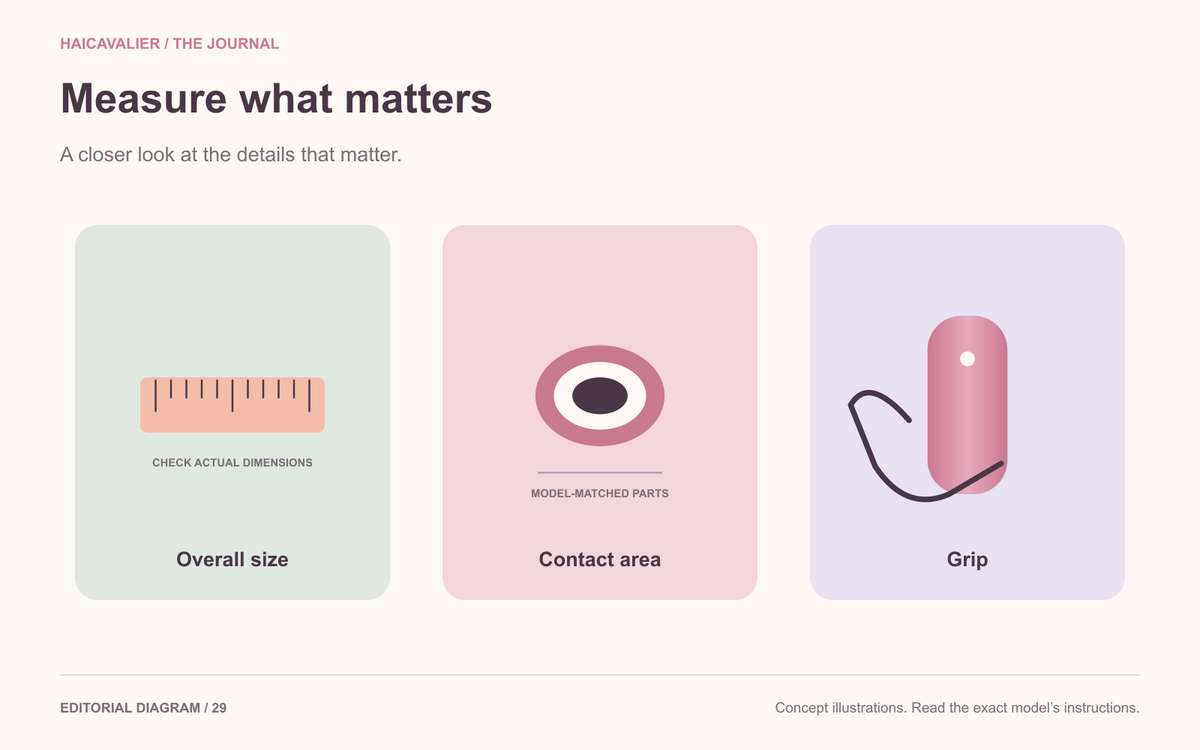
Choose vibrator size using the relevant measurements, available grip and complete storage space. “Mini,” “compact” and “full-size” have no shared dimensions across listings.
Total length alone cannot explain how an external head, handle or opening is shaped.
Start with the stated intended use
For an external model, head width, contact area, opening dimensions and button reach may matter more than overall length.
For a model intended for internal use, distinguish its stated usable dimensions from total housing length. Do not estimate a missing measurement from a photograph.
A small physical size does not make a product appropriate for an unintended use.
Compare the measurements that answer your question
Find length, width and weight, then identify exactly what each describes. Where relevant, request separate head and handle dimensions.
Convert the shortlist to one unit. One inch equals 2.54 centimeters, so a 4-inch body is 10.16 centimeters; that conversion says nothing about the head width or weight.
Ask for a missing dimension instead of treating an unknown photo prop as a scale.
Make a paper outline
Mark the listed length and width on paper. Put it beside the storage compartment you plan to use.
Add space for the case, cable and permitted removable pieces. An outline is a scale check, not a test of bodily fit or a prediction of comfort.
If the device fits only when a cable is sharply bent or a button is compressed, revise the storage plan.
Check the compact-control trade-off
A smaller housing can save drawer space while leaving less grip room or placing buttons close together.
Read the off sequence and how to decrease a setting. A one-button mini may require more cycling than a larger panel with separate controls.
“Best mini for beginners” is not a substitute for this check. The useful question is whether you can manage that model's controls.
Choose the compromise that matters to you
If your priority is compact storage, compare the packed kit. If it is handling, compare grip area, weight and reach. They can lead to different choices.
Do not infer strength, starting intensity, noise or battery life from the silhouette. Those are separate specifications.
A size decision is complete when you understand what the measurements mean and which physical trade-off you prefer. It does not need to match anyone else's first purchase.