Buying Guides
How to Compare Vibrator Noise Levels Before Buying
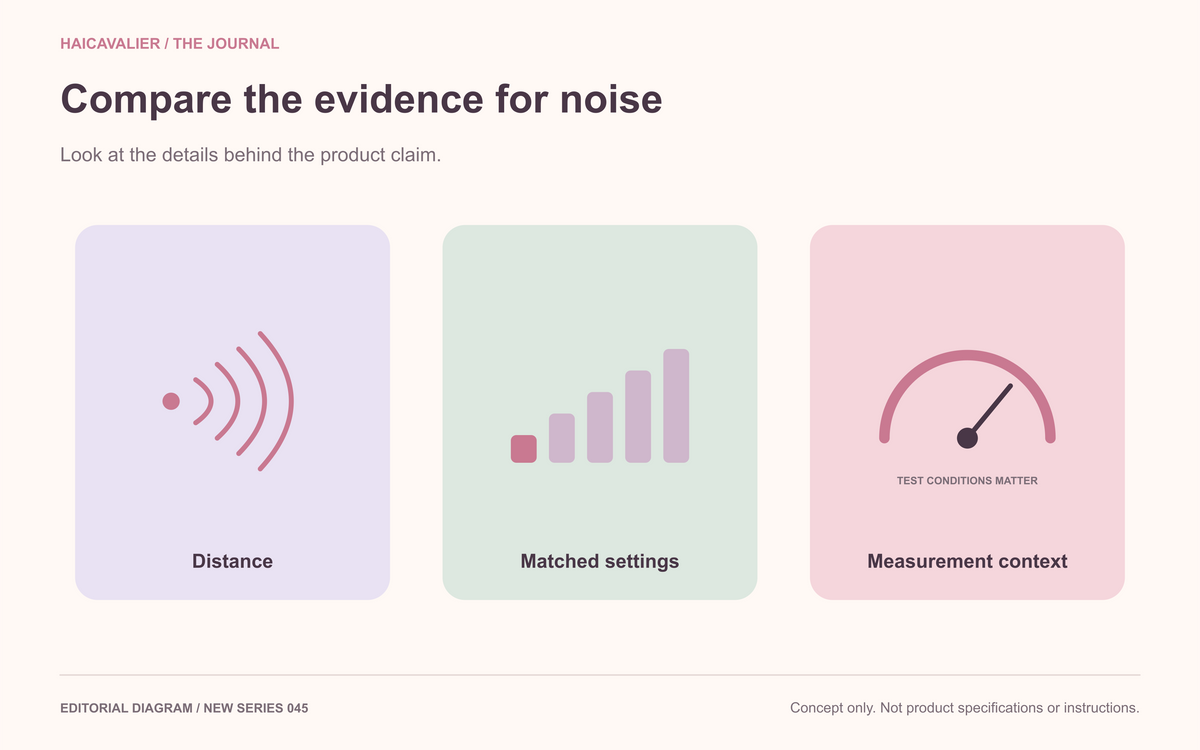
Compare vibrator noise claims only when you know the operating setting, active functions, measurement distance and test conditions. A decibel number without that context cannot reliably rank two devices.
“Whisper-quiet” is a description, not a standardized product grade.
Put the evidence into a comparison
| Evidence | What to look for | Limit |
|---|---|---|
| Measured sound level | Distance, setting, active functions, instrument and background conditions | Different test setups may not be comparable |
| Product recording | Continuous demonstration with settings identified | Microphones and playback affect apparent loudness |
| Customer review | Specific model and circumstances | One household does not represent another |
| Quietness adjective | Supporting measurement or demonstration | The wording alone establishes no level |
Compare like operating conditions
A lowest-setting result for one device should not be ranked against maximum combined output from another.
For example, a hypothetical lower number measured farther away on one function does not prove a quieter device than a higher number measured nearby with two functions running.
Record whether the device was held, mounted or resting on a surface. Keep any stated weighting or averaging method with the result rather than comparing isolated numbers.
Are suction-style devices louder?
The category name cannot settle that. Identify whether the particular model runs air-pressure operation, vibration or both during the demonstration.
Ask to see those functions identified. A recording of only one does not describe the combined setting.
A small shell, silicone finish or discreet appearance also cannot establish the noise level.
Use videos for a narrower question
A video may reveal a changing sound character, an obvious rattle or the difference between settings in that recording.
It cannot recreate absolute loudness in your room without a controlled recording and playback arrangement. Editing, microphone processing and speaker volume all matter.
Increasing your playback volume does not reproduce a particular listening distance.
Keep household privacy separate
Sound transmission depends on the room, surfaces, background sound and building. Ordinary product evidence cannot promise that no housemate will hear anything.
Likewise, neutral packaging says nothing about operating sound. Evaluate delivery privacy separately.
Build an honest shortlist
For each candidate, mark the noise claim as measured, demonstrated or simply described, and write down the missing conditions.
If sound is decisive and support cannot clarify the evidence, keep that uncertainty in the decision.
This is an evidence-reading guide rather than a tested “quietest vibrator” list. There is no reason to invent a winner from incomplete measurements.
Related reading
Reference
CDC/NIOSH: Understanding noise measurements — measurement context; this is not a test or endorsement of any vibrator.