Buying Guides
Silicone vs ABS Vibrators: Materials Explained

Silicone and ABS are not two quality grades of a vibrator. They are different material categories that may serve different jobs in one device. The useful comparison is how a particular component feels and behaves, and whether that matches the design you want.
This guide compares those design choices. For checking material declarations and testing claims in more depth, use our vibrator materials guide.
Silicone and ABS at a glance
| Comparison | Silicone component | ABS component |
|---|---|---|
| General material type | Silicone rubber, when the listing specifies an elastomer | A rigid thermoplastic |
| Design role | Can provide a flexible or softer-feeling surface or part | Commonly provides a structured housing or handle |
| What to compare | The actual firmness, thickness, finish and underlying structure | The shape, surface finish and how the rigid part fits your grip |
| What the name cannot establish | That the whole device bends, is safe for every use or can be boiled | That the whole device is waterproof, uncomfortable or lower quality |
These are general design distinctions, not specifications for every vibrator. Material suppliers offer silicone rubber in different hardness grades and ABS for housing applications. Neither category gives a universal sensation or a finished-product certification.
If you want a softer-feeling contact surface
Silicone is often selected where a flexible or softer-feeling component is wanted. However, a silicone surface over a firm internal structure can behave differently from a thicker flexible component. A soft surface and a bendable device are separate questions.
Ask whether the manufacturer describes the firmness of the actual contact part. A photograph cannot verify the material declaration, and a soft-looking color cannot tell you how a surface feels. Do not treat the word silicone as a promise of one particular texture.
If you prefer a structured shape or handle
ABS is a rigid plastic used in housings and other structured parts. When comparing a rigid handle, consider its dimensions, contour, button placement and whether you can hold it the way the model is intended to be used.
Rigidity is a design characteristic, not a ranking. A shopper may prefer a structured grip while also wanting a different material at the contact surface. Likewise, an ABS component alone does not establish the finished surface quality or suitability for an unintended use.
When both materials appear in one model
Consider two hypothetical listings: “silicone head, ABS handle” and “silicone and ABS.” The first maps materials to parts; the second leaves that work to the shopper.
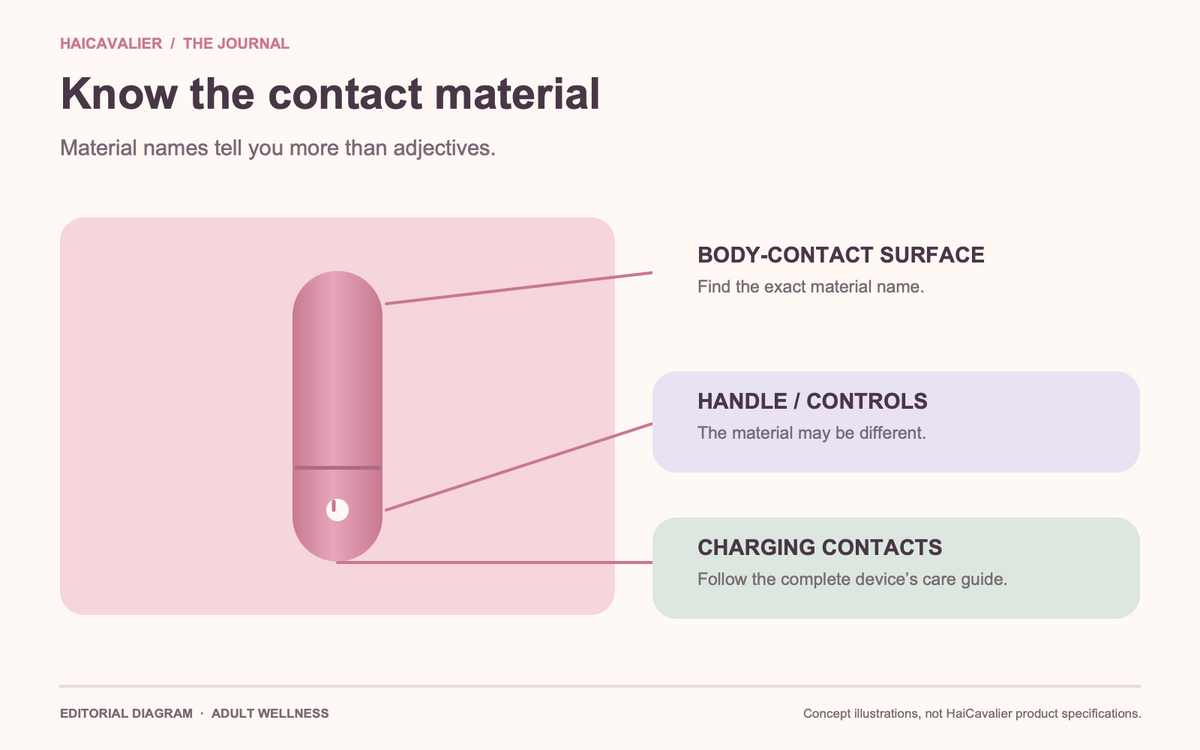
Identify the body-contact surface, handle, buttons, removable pieces and charging area. Ask whether silicone describes a molded component or a surface layer. Neither listing establishes the feel of the entire device without its dimensions and construction details.
Compare care as part of the design
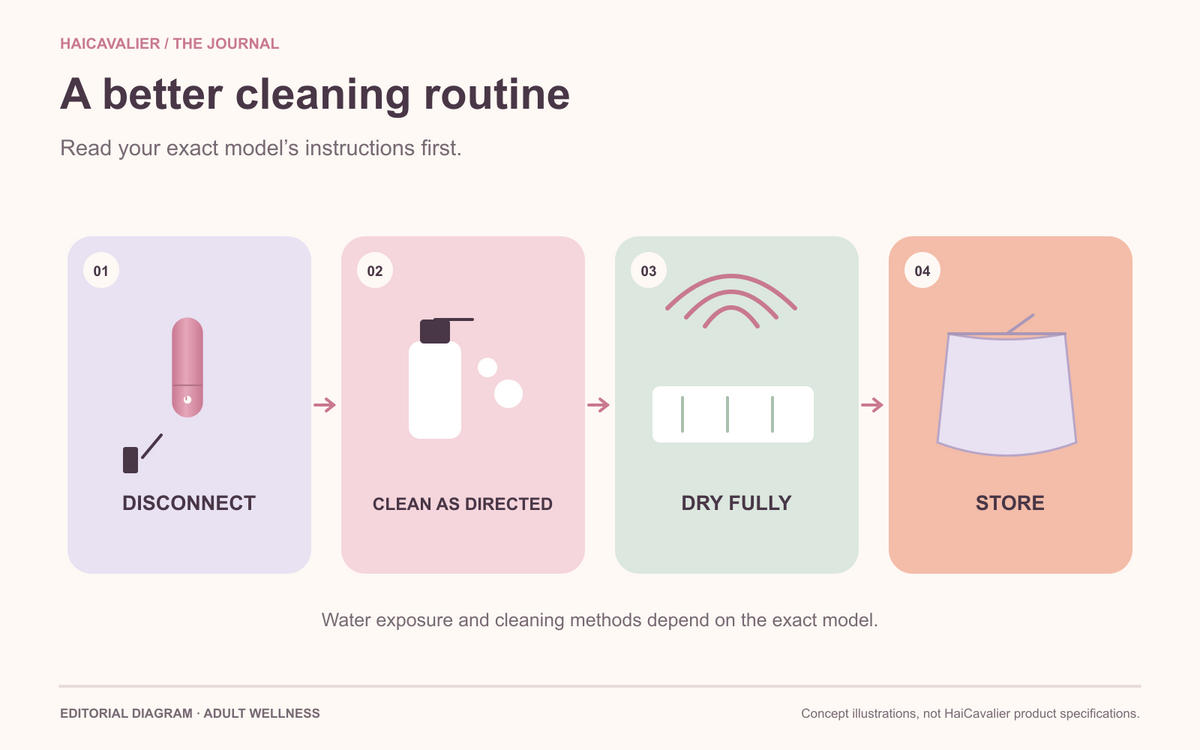
The practical difference between two models may be their maintenance rather than their material labels. Compare the instructions for water exposure, approved cleaners, drying, lubricant compatibility and storage.
A material's properties do not establish what electronics, joints and seals tolerate. A surface description is not permission to boil an electronic device. If a head is removable, find out whether its care differs from the body; never force a piece off because it appears to be a separate material. Read both the device and lubricant instructions and ask before using an uncertain combination.
Choose a preference, then verify the whole product
Write down the design preference you are comparing: a softer-feeling contact part, a structured handle, or a particular combination. Then check whether the actual model supports that preference through its component description, dimensions and intended use.
Naming a material does not automatically verify every safety or performance claim. Ask what “body-safe” means for that model and request the standard, report scope and product identification behind any testing statement. “Premium silicone” does not identify the other materials in a device.
You should be able to explain which part touches the body, what that part is made of and how the complete product is maintained. Keep the model's manual so you can return to its instructions later. The stronger choice is the understandable design that fits your preferences, rather than a material name chosen in isolation.
Related reading
Sources
- WACKER: Solid and Liquid Silicone Rubber — material-grade hardness and mechanical-property information; not a certification for HaiCavalier products.
- INEOS Styrolution: ABS for Housing Applications — an example of ABS use in structured housings; not a finished-product safety claim.
- Planned Parenthood: Sex Toys and Material Considerations