Buying Guides
Vibrator Materials: How to Read What a Product Is Made Of
A useful vibrator material description identifies each body-contact surface and explains how the complete device is maintained. “Soft-touch,” “premium” and “body-safe” leave important questions unanswered.
Start with composition, then construction, then care.
Map the materials to the parts
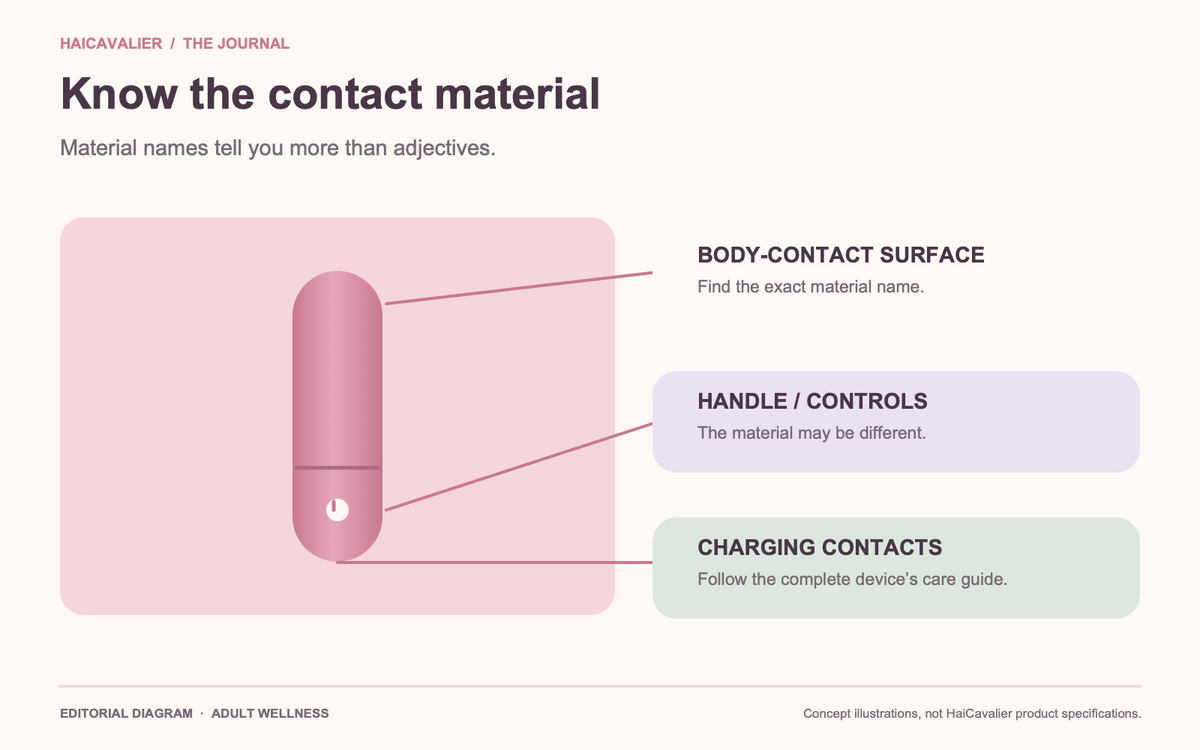
A single device might have a silicone contact head, a rigid ABS handle, separate buttons and metal charging contacts.
“Silicone and ABS” is incomplete if you cannot tell which material is used where. Ask for a labeled diagram or written component list, including whether a statement describes a solid part or a coating.
Check removable accessories separately. They may not be made from the same material as the body.
Separate softness from material identity
Softness, flexibility and surface texture are different properties. A flexible neck does not establish a soft contact surface; a matte finish does not establish silicone.
You cannot verify composition from a color or photograph. For a “soft-touch” claim, ask whether it describes molded material or an applied finish and whether the care requirements differ.
This is particularly useful when comparing two products whose photos look almost identical.
Why nonporous materials appear in guidance
Planned Parenthood recommends nonporous materials for internally used toys, including 100% silicone, hard plastic, stainless steel and suitable glass. This is a hygiene consideration, not a certificate for every product using those materials.
The declaration does not establish the condition of a finished surface, electrical design or suitability for an unintended use. Read the material information together with the model instructions.
Assess the whole device
For silicone models, compare contact-surface information, joins, buttons, charging arrangements and cleaning access. The word silicone alone cannot produce a “best” ranking.
Ask what supports a testing claim: the product identifier, standard or method, report scope and responsible organization. A report about raw material does not necessarily cover the complete electronic product.
Do not attempt a flame, solvent or other destructive home test to identify a material.
Follow the finished product's care limits
A heat-tolerant material does not make an electronic device suitable for boiling. Likewise, a water-tolerant head does not establish that its handle can be immersed.
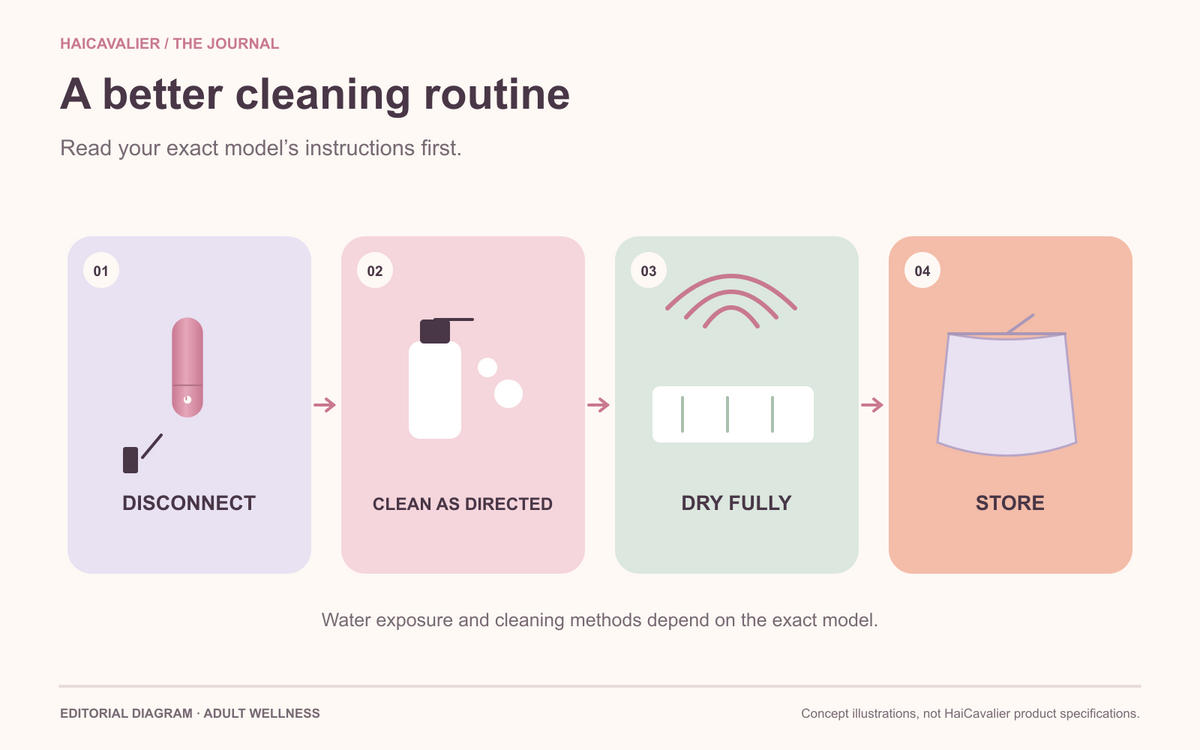
Check permitted cleaners, lubricant compatibility, drying and storage. If the device and lubricant instructions do not clearly support a combination, ask before using it.
Stop using a surface that cracks, peels or develops an unexplained sticky texture. A powder or extra coating does not restore it.
A message worth sending before checkout
“Which material forms each body-contact surface? Is it a coating or a solid component? Where are the care instructions for this model?”
Those answers make a useful comparison. An expensive-looking box does not.
Related reading
- Cute Vibrators: What to Look for Beyond the Color
- How to Choose Your First Vibrator Without Overthinking It