Buying Guides
Vibrator Shapes Explained: How to Choose

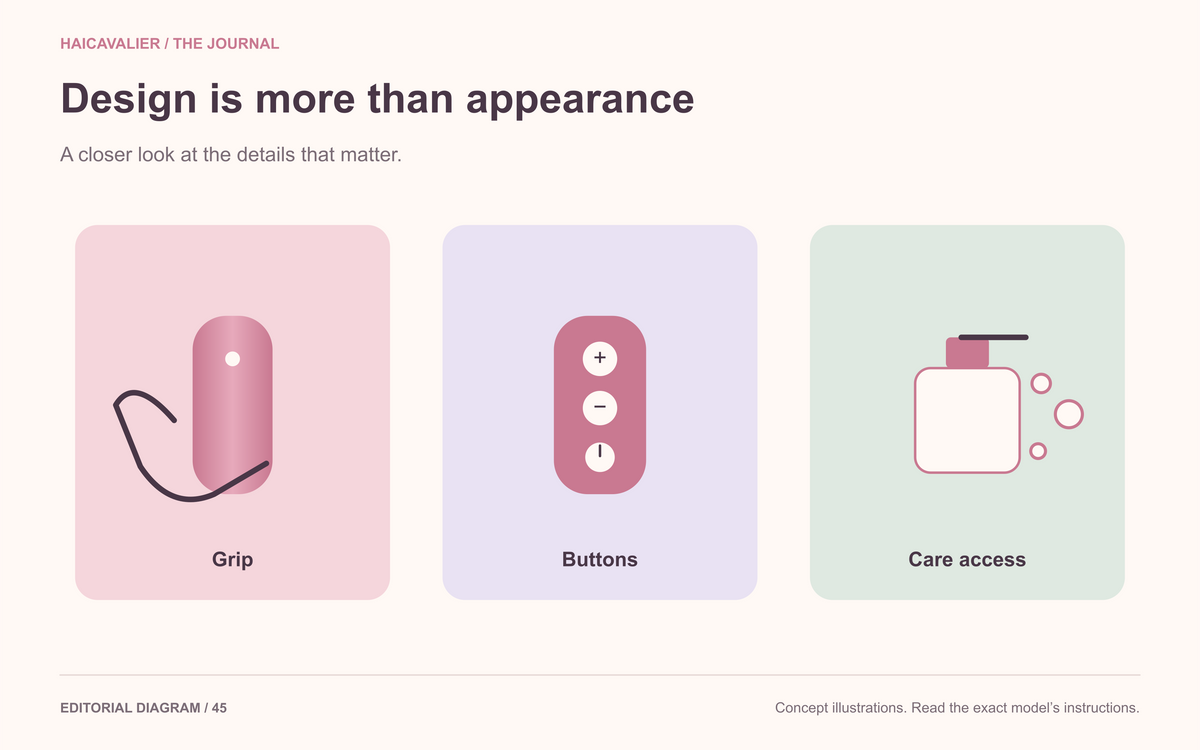
Choose vibrator shape by dividing the device into three areas: the contact surface or opening, the grip and the controls. Then compare the actual dimensions and weight for the intended use.
An ergonomic label, curved outline or compact body cannot establish that one shape suits every hand.
Identify the purpose before the silhouette
Read the manufacturer's intended use and mechanism. Similar-looking shapes can contain vibration, air-pressure operation or a combination.
A small size does not make a device suitable for every body area. Nor does a curve prove flexibility.
Once those basics are clear, compare physical handling rather than category nicknames.
Inspect the three areas
Contact area: look for a clear head view and relevant dimensions. For a model with an opening, inspect that opening separately from the housing.
Grip: find the space intended to be held, its thickness and the device weight. A roomier handle may be useful while taking more storage space.
Controls: locate buttons on the back and sides. Check whether reaching them could require changing your grip.
A front photograph rarely answers all three.
Make “ergonomic” specific
Ask what the claim refers to: a grip surface, button spacing, weight distribution or a movable neck.
Then relate that feature to your own handling priority. A compact device with close buttons may suit one person and be awkward for another.
Product measurements can support a comparison; they cannot guarantee personal comfort.
Compare a realistic trade-off
Suppose one candidate has a short body and tiny controls while another has a longer grip with separate buttons.
If storage is decisive, measure both packed kits. If button reach matters more, read the control sequences and compare the usable grip space.
Do not assign the smaller model a lower intensity or quieter operation from its outline. Those are different questions.
Read seams and joints correctly
A visible joint does not necessarily detach. A bend in a photo does not define a permitted movement range.
Use the manual for removable and flexible parts. Check whether recesses or decorative details require a particular cleaning method.
If the design requires care you cannot follow, its visual appeal does not resolve that practical problem.
Narrow the choice
Compare two models with the same intended use. Write the preferred compromise in one sentence: “I want more grip room even if it needs a larger pouch.”
That is a clearer basis for choosing than assuming curved, flexible or mini is universally better.