Start Here
How to Understand Vibrator Intensity Settings
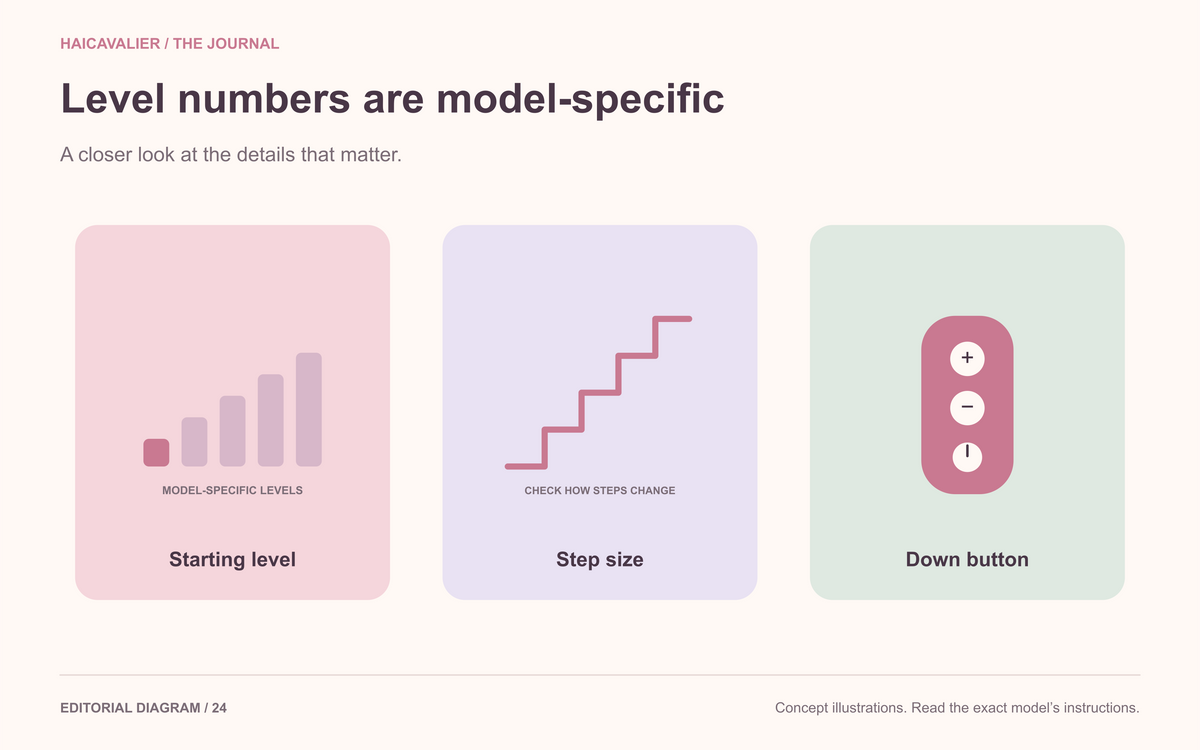
Vibrator intensity levels belong to the individual model, not a universal strength scale. Check what the levels control, how the device starts, and whether you can decrease a setting directly.
Keep intensity levels separate from patterns and from measurements such as frequency.
Find out what the numbers count
A product may list intensity levels, patterns, combined modes or several separate functions. Read the explanation before comparing totals.
Ten patterns are not necessarily ten steady operating levels. A combination device may count settings for one function while describing another separately.
If the listing does not distinguish them, ask. A large number without a definition is difficult to use.
Look at the starting behavior
Does the model begin at its lowest level? Does it recall a previous choice? Does the same button turn it on and change the setting?
Those questions can matter more than the maximum number.
You may prefer a predictable default, or you may like memory. Neither feature is automatically right for every adult. The useful part is knowing what will happen.
Compare the steps between levels
A list of level numbers does not explain how each change will feel. Product descriptions may offer some context, but they cannot predict your individual response.
More levels do not necessarily mean a more suitable range. Fewer levels do not necessarily mean crude control.
Keep the comparison focused on what can be established: how adjustments work, which functions change and whether a lower level can be selected directly.
Distinguish intensity from rhythm
A steady setting and a pulsing pattern can be different options. A pattern changes the output over time; intensity concerns an operating level or range.
Some models allow both to be adjusted. Others offer fixed combinations. Read the instructions rather than assuming separate control.
This distinction helps you understand why two mode counts may describe very different interfaces.
Give the down and off commands attention
A clearly labeled increase button is only part of the interface. Find out how to reduce a setting and switch the product off.
If a device cycles through every option in one direction, decide whether that suits your preferences. A compact one-button design can be simple to look at without being the simplest sequence for you.
A diagram or demonstration of the actual buttons can help.
Leave room for your own preferences
There is no requirement to work toward a higher setting. A higher number is not an achievement.
Follow the intended-use instructions and stop if anything is uncomfortable. Persistent pain or irritation should be discussed with a qualified healthcare professional.
Choose settings for comfort, and choose a product whose controls make those decisions easy to understand.
Read a control sequence before comparing level counts
Imagine one model with separate plus and minus controls and another with a single button that cycles through all settings. Either could list the same number of levels.
Write the steps needed to move down one level and switch off. Then check whether restarting recalls the previous selection.
That sequence tells you more about everyday adjustment than the level count alone. It does not predict which setting will feel right to you, and there is no need to progress to a higher number.