Buying Guides
How to Read Vibrator Product Specifications
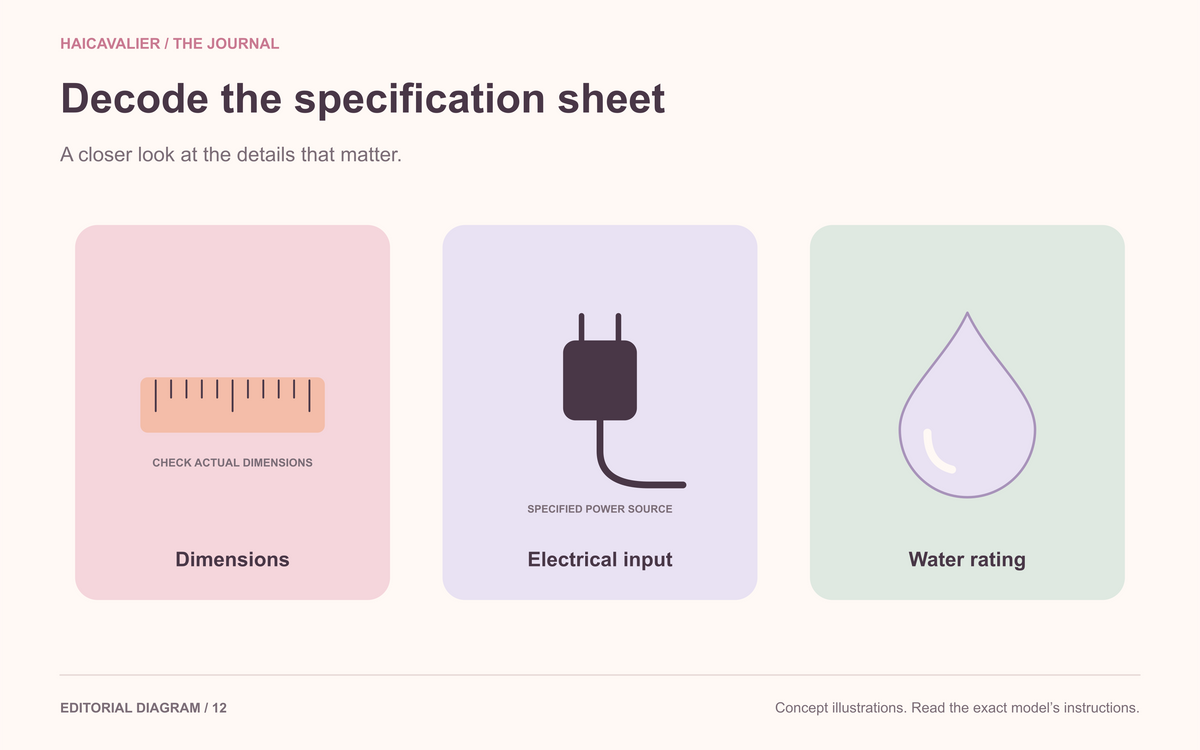
Read vibrator specifications by separating purpose, physical measurements, controls, materials, power and care. Numbers are useful only when you know what was measured or counted.
In particular, total length is not head size, battery capacity is not operating runtime, and a mode count is not automatically an intensity range.
Start with intended use
Before comparing numbers, find out what the model is designed to do. Check whether it is external, internal or combines different functions.
Do not infer intended use from a nickname or shape. The written instructions should make the purpose clear.
If a listing and manual seem to describe different products, ask the seller to confirm the exact model before ordering.
Break dimensions into useful parts
Look for length, width and weight, with a clear indication of what each measurement describes.
For an internal product, distinguish total length from any stated insertable length. For an external product, head dimensions and available grip may be more relevant.
Use the same unit across your shortlist. Measurements in both inches and centimeters can make comparison easier for US and Canadian shoppers.
Read material declarations by component
Identify the body-contact surface separately from the handle, buttons and charging area.
“Silicone and ABS” is incomplete if you cannot tell which material is used where. Ask whether a material statement refers to a component, coating or full surface.
Aesthetic descriptions such as “soft-touch” do not replace the material name.
Separate settings from controls
Ten patterns are not necessarily ten intensity levels. A model may have both, with different ways to change them.
Find the control sequence and check whether functions can be adjusted independently. Look for a clear off command.
A settings count is useful only after you know what is being counted.
Understand the power information
Charging input, battery capacity, charging time and operating runtime describe different things.
A capacity number alone does not establish how long the assembled product will run. Look for stated operating conditions, particularly if several functions can operate together.
Use the specified charging equipment and power requirements. A connector that looks familiar is not the complete compatibility specification.
Find the limits behind a water claim
Read the exact water-resistance statement and care instructions. Words such as “waterproof” can conceal conditions concerning depth, duration or which parts may get wet.
A bath-themed photograph is not a technical statement. Neither a rating nor a marketing phrase should be treated as permission to charge while wet.
Mark the missing answers
Create a short comparison with rows for purpose, dimensions, materials, controls, power and care. Leave missing details blank instead of filling them in with assumptions.
Those blanks are your questions for support. A useful product specification helps you choose; it should not require you to reverse-engineer the listing.
Translate a sample feature panel
Suppose a hypothetical listing says “ten modes, USB rechargeable, silicone and ABS.” You still need to identify how many steady levels and patterns it includes, which device-end connector it uses, and where each material is located.
Write those missing answers beside the original claims rather than silently filling them in.
Then read the manual. The purpose of a specification table is to make that exact model comparable, not to collect the largest numbers or the most technical-sounding labels.